The Career Path Most Design Students Never Hear About
There's a version of the design industry that doesn't show up in most school curricula. It's not branding agencies, editorial publishing, or UX at a tech company. It involves working with a five-week deadline, and watching something you designed in Illustrator play in front of an entire arena filled with 16,000 people!
It's live event production — and most designers have no idea it even exists.
syracuse students come to proscenium
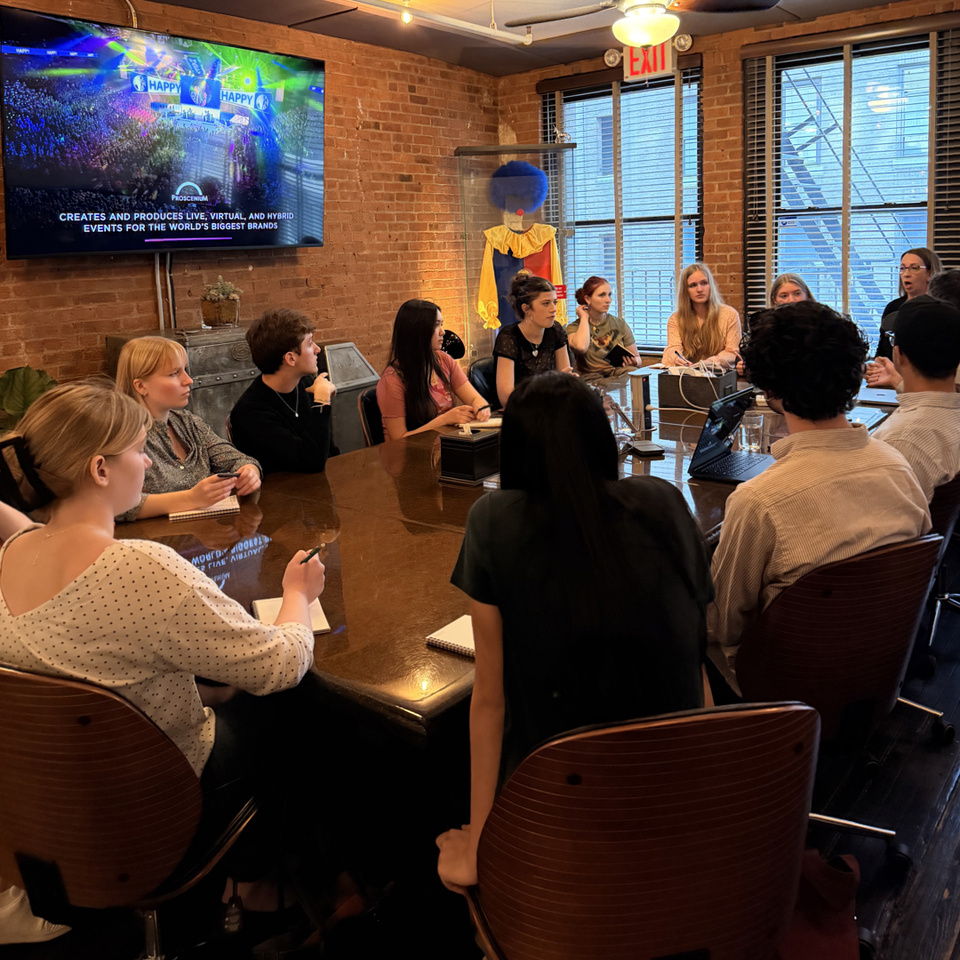
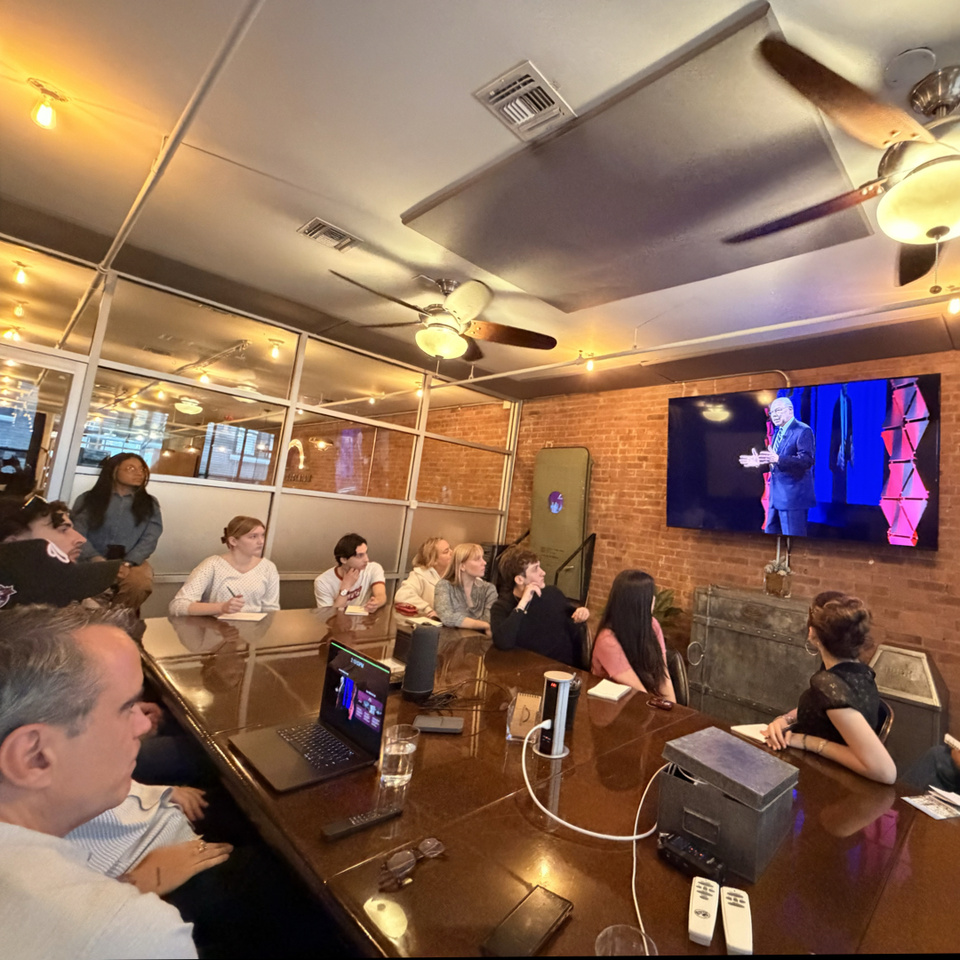
Earlier this month, we had the pleasure of hosting a group of sophomore design students from Syracuse University's Visual Performing Arts (VPA) program at our office. What started as an informal visit turned into one of the more energizing afternoons we've had in a while. The questions they asked were sharp, the curiosity was real, and it reminded us why we love inspiring young people to go into this industry.
Chuck Santoro, Proscenium's co-founder and creative lead, is a Syracuse alum himself (VPA, musical theater). When he graduated, this world didn't exist on his radar either. He's been going back to speak to students for years, because he believes the gap between what design schools teach and what event production actually needs is something worth closing.
Of course, corporate events as we know them have existed for a long time, check out our ProCast episode with Steve Young to learn more about the Golden Age of Industrial Musicals.
So What Does a Designer Actually Design Here?
The short answer: just about everything the audience sees.
Our Head of Design, Christian Bayonet, walked the students through a cross-section of our work — T-Mobile, SAP, Harley Davidson, Orion, Lowe's — and the through line was the same every time:
A corporate event isn't just a stage and some chairs. It's a complete visual environment.
That means:
- Stage content and motion graphics: Everything playing on LED screens, including animated idents, 3D sequences, keynote backdrops, and concert visuals
- Environmental and venue branding: Column wraps, stairwell decals, printed signage, registration experiences, way-finding
- Print collateral: Name badges, t-shirts, lanyards, debit cards, amenity kits, stickers
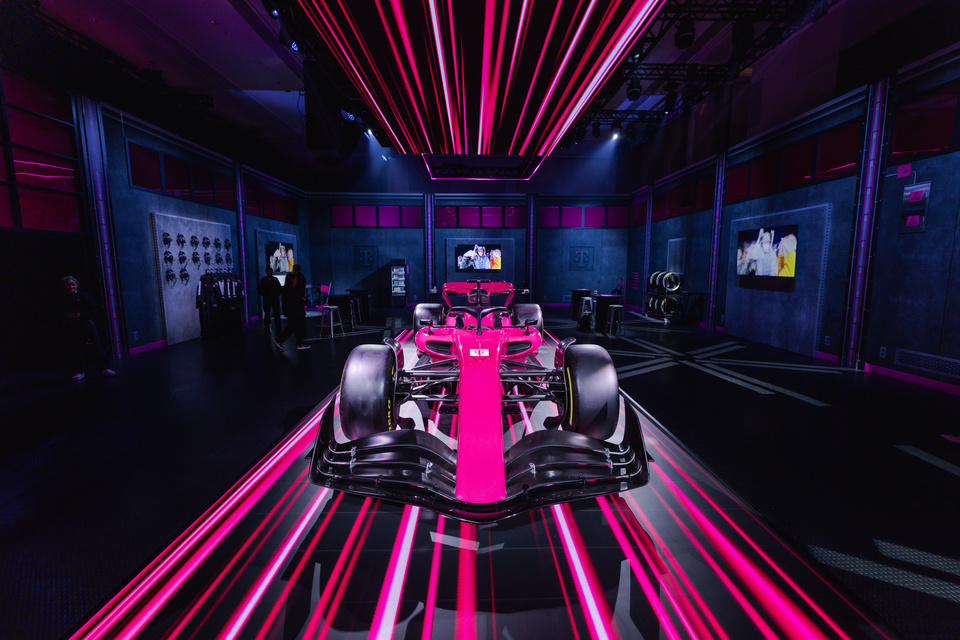
- Fabrication design: Walls, structures, and scenic elements built to look like real spaces (see: a full garage for T-Mobile's F1 event in Las Vegas constructed entirely in Illustrator and Photoshop because no scene shop could turn it around in five weeks)
- Event-specific sub-branding: Taking a client's established brand and extending it into a unique visual identity for a specific event
- The team touches every one of those touchpoints. There's no one on staff who only does print. There's no one who only does digital. Every designer works across the full canvas.
the f1 story
The question students kept returning to was: how do you handle impossible timelines?
The T-Mobile F1 event in Las Vegas is a good answer. We got the call five weeks before load-in. The original plan called for hard scenic walls to make the space feel like a real garage. We called every scene shop in California. No one would take the job.
So the design team made fake walls look real — toolboxes with shading, soffits with depth, textures and materials rendered entirely in Photoshop and Illustrator. Nothing in that garage was physical except the windows and a car. The rest was graphic design at scale.
It's one of the projects our team is most proud of. Not because it was glamorous — it wasn't, five weeks before a major event rarely is, but because the solution was purely creative. The constraint became the design.
A Different Kind of Career Ladder
One of the things Christian talked through with the students was how the career path actually works inside a studio like ours.
You can enter as a junior graphic designer, assisting with concept development, preparing production files, translating brand guidelines into event visuals. From there, the progression moves toward art director, senior art director, and eventually head of design. What distinguishes the levels isn't just skill, it's scope. A senior art director is setting the visual direction for an entire event, managing other designers, presenting work to clients, and overseeing every design touchpoint from stage to swag.
Shraddha, one of our graphic designers, came in as a design intern. Nine years later, she's still here. Christian came on as a freelancer for a single T-Mobile project. Ten years later, he leads the department. That's not unusual for this industry. When the work is good and the projects keep coming, people stay.
what the student asked
The questions in the room were some of the best we've fielded.
A few that stuck with us:
-
On creating for unconventional surfaces: How do you design for a dome, or a ceiling LED array, or a nightclub's column screens? The answer involves pixel maps, technical design templates from AV partners, and different software depending on the surface. The design process changes, but the principles don't.
-
On resolution at scale: Students asked the logical question: how do you design a graphic for a laptop screen that looks good on a 60-foot LED wall? The counterintuitive answer is that many large-format LED screens still run at 1080p. Resolution is pixel-based, not size-based. You design once, and it scales.
-
On sustainability: What happens to all of it after? The LED and lighting equipment goes back to the AV rental companies. The print materials usually end up being recycled. It's something we actively think about, especially across multi-show runs for the same client where elements can be repurposed or reused.
-
On creative latitude: Some clients give you two colors and a logo and say "go". Others, like T-Mobile, have detailed brand standards that govern everything. Both are interesting challenges. The skill is knowing how to be creative within a given set of rules.
A few that stuck with us:
If you're a designer wondering whether the events industry might be for you: the honest answer is that it's not for everyone. The timelines are compressed, the stakes are high (you open and close on the same day, and there's no do-over), and the volume of deliverables per project is significant. But if you like working across media, want to see your work at scale, and don't mind the particular thrill of a deadline that's actually a deadline, this career path is worth knowing exists.
We're glad the Syracuse students were so interested and engaged. We hope to see them again, maybe in a ballroom or convention center, sometime soon.
